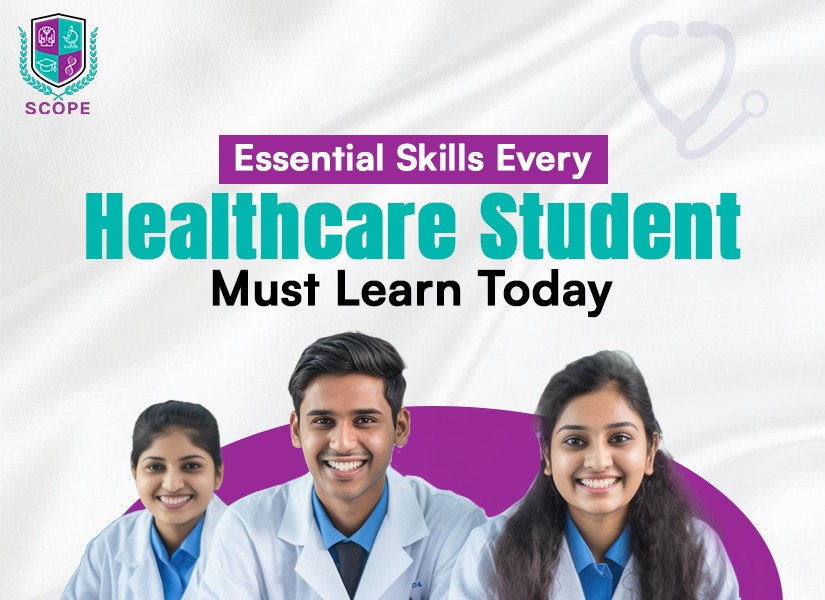
Healthcare is an industry that never stops growing in demand, whether among students seeking to become well-established professionals or the general public. As for the medical or paramedical needs of the public, they simply never end, and to adhere to them, the sector keeps on demanding more and more knowledgeable, skilled, and qualified professionals. Hence, during their studies, there are several essential skills for healthcare students for the survival of their professional careers, including both soft and hard skills used in their daily lives.
Important Soft Skills for Healthcare Professionals
The first thing that is seen in healthcare workers before their work is their professionalism. This professionalism acts as their first impression and makes an individual instantly build a review around them, as well as making you feel likable or unlikable. This personality and showcase of professionalism is elevated with the presence of appropriate soft skills for healthcare professionals, such as:
- Time Management
In a busy medical environment, time management is an essential skill for you, even in a professional environment, as well as during your studies. The following are some things that prove the importance of time management for you as a healthcare professional:
- Prioritizing tasks leads to better time management, as it helps you handle a critical patient sooner than a less urgent one.
- As you manage time, you would obviously be working on time, along with good accuracy maintained in the treatment you give to the patients.
- When you complete your work on time, it will benefit you by reducing stress and fatigue.
- Confidence
When you are confident, you look like a better professional in front of the patient than someone working under stress, pressure, and limited skills. Being full of confidence helps you in:
- Reflecting your expertise in different tasks or responsibilities.
- Enhancing the trust of the patient.
- Acquiring the trust of your team and reducing the stress of the environment.
- Developing leadership skills.
- Empathy
In the healthcare sector, you get to meet people of varying natures, medical problems, needs, and backgrounds in your daily life. As a professional, you need to show empathy towards them and give the best possible treatment or advice to them all. Showing empathy helps in several ways, such as:
- Shows your sensitivity towards the patient’s situation.
- The patient gets emotional support during their treatment.
- Reduces the stress of the patient.
- Critical Thinking
While working in a medical body, there are several instances when you have to handle emergency cases, and strong critical thinking skills help in problem-solving in healthcare quickly. Developing critical thinking skills helps in the following ways:
- Makes you analyze the patient’s required treatment and symptoms quickly.
- Enables you to decide whether the patient should be high on your priority list or not.
- Reduces errors during your tasks.
- Providing immediate treatment with accuracy in emergency cases.
- Communication and Teamwork
While working in a crowded environment like a lab or a hospital, you need to have proper communication skills in healthcare, along with teamwork and collaboration skills, to care for your patients as well as your team and to give the best results. Here is how these skills help:
- Effective communication with patients helps you better understand their problem and, with your team of seniors or juniors, find the best treatment for them.
- Communication also helps in avoiding misunderstandings that can prove to be harmful for the patient later on.
- Teamwork, along with communication, makes the team work the best towards a common goal.
Important Hard Skills for Healthcare Professionals
Besides just looking professional, a healthcare professional should focus slightly more on what kind of treatment they are giving to a patient in need, which is elevated by their hard skills. These include practical abilities critical during diagnosis and treatment, as well as emergency response.
- CPR
CPR is a life-saving emergency technique that is among the most basic skills every healthcare professional should know today, as it can be used at any time. The steps of CPR include chest compressions, rescue breaths, and the use of an Automated External Defibrillator (AED). Regular practice of the CPR technique ensures perfection.
- Vital Signs Monitoring
While treating a patient, a fundamental step to follow is to monitor their vital signs, such as pulse, blood pressure, temperature, and respiratory rate. The regular fluctuations or stability in these signs are monitored to assess a patient’s medical needs and overall health.
- You must know what level of vitals indicates danger.
- The knowledge of reading and using instruments like thermometers, sphygmomanometers, and pulse oximeters is necessary to monitor the vitals.
- Along with monitoring, the readings of the vitals should be accurately recorded.
- EMRs
The use of electronic medical records (EMRs) is a necessity in the modern era of healthcare, as they greatly facilitate the storage of patient data. The following are some benefits of using an EMR:
- They help in faster onboarding of patients.
- Data is stored precisely, preventing any miscommunication or future errors.
- Data like lab reports, billing, and patient history is streamlined and secured.
Conclusion
To establish yourself in your career as a professional healthcare worker, whether in the medical or paramedical field, having a blend of soft and hard skills is essential. These skills include communication, critical thinking, time management, confidence, and empathy, along with monitoring vital signs, EMRs, and CPR. To be ready for a professional career, these skills can be best implemented when learned during your preparation or education days.
If you wish to develop these skills along with gaining the best quality of education, then Scope College is the perfect place for you. We at Scope College offer bachelor’s, diploma, and certificate courses, allowing you to enter the paramedical field with specialization in cardiology, medical laboratory technology, radiology, dialysis, ECG, X-ray, MRI, etc. Our courses make you job-ready to land a role at one of our 300+ placement partners, just like the 6,000+ students we have trained over the past 12 years.
The premium facilities at our college include an excellent laboratory setting and faculty full of experts, along with a 100% placement record. If you plan to step into the healthcare sector as a healthcare professional, Scope College is the best place to mark the beginning of your advanced career.
FAQs
Why are soft skills important for healthcare students?
The most important soft skills for healthcare students include those like communication, teamwork, work ethics, empathy, confidence, time management, critical thinking, etc.
What are vital signs, and why must students learn to monitor them?
It is essential that you learn to monitor a patient’s vital signs, as this is the most basic step in assessing the patient’s well-being and determining what steps need to be taken next in the treatment.
Why is confidence important in healthcare?
Confidence is one of the best qualities of a healthcare professional, as it enhances a patient’s trust in them and motivates them to treat the patient the best way possible.
Why is critical thinking important in healthcare?
Critical thinking is essential in healthcare, especially in emergency cases, as it helps analyze a patient’s condition, evaluate the risks and benefits of various treatment options, and provide the best possible care in a time of need.
Why is empathy so important in health care?
Empathy is important in healthcare, as it helps the patient connect with you positively and view you as a trustworthy professional, and makes them feel valued.