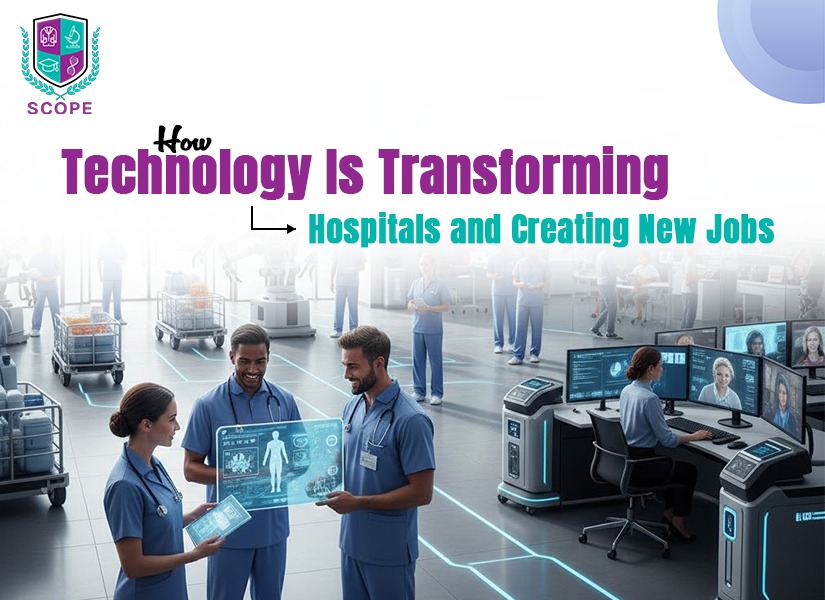
Healthcare is one such field where we are underappreciating the technological advancements. Imagine hospitals a decade ago. Compared to any modern hospital today, we have achieved digital screens, robotic devices, AI-powered diagnostic tools, etc. The progress of technology in healthcare is appreciable—it’s happening at lightning speed, for perspective.
These advancements are not only enhancing patient care but also creating numerous career opportunities for students and professionals. If you are an individual motivated by the healthcare field, the awareness of these opportunities is vital. In today’s blog, we’ll explore how technologies such as AI, robotics, and digital health solutions are transforming hospital employment dynamics in India and around the world.
AI in Healthcare: Smarter Diagnosis & Faster Decisions
AI isn’t just limited to the chatbots you use daily. It has advanced much more, even across the healthcare field. It is transforming diagnostics, treatment planning, and hospital workflow management. You can find AI in:
- Radiology: AI scans X-rays, CTs, and MRIs with high accuracy.
- Pathology: Machine learning helps detect early cancer and other diseases.
- Patient triage: AI chatbots guide patients based on symptoms.
- Predictive analytics: Helps hospitals forecast patient inflows, shortages, and emergencies.
For example, an AI tool like MediSearch can act as the first point of contact for patients in diagnosis and initial treatments. This pace can lead to early uptake of treatment courses, helping doctors make quicker decisions and save lives.
Robotics in Hospitals: Automation, Surgery & Efficiency
Robots are the new assistants to doctors (and believe us, they are not taking away your jobs; they need operators)! Surgeries and hospital processes have become more precise, safe, and efficient. Robotics is in:
- Robotic-assisted surgeries: Systems like the Da Vinci Surgical Robot offer precision and minimal invasion.
- Sanitization robots: Automated machines disinfect COVID wards and ICUs. (For example, those automatic cleaners you find at hospitals.)
- Medicine delivery robots: Reduce human movement and improve patient safety.
- Robotic pharmacy systems: Automate drug dispensing to reduce errors.
What robotics has added: Speedy hospital operations, more effective treatments, and skilled operator jobs.
What robotics has subtracted: Human errors, manual and repetitive tasks.
Major Medical Technology Advancements Shaping Healthcare
While AI and robotics are the principal advancements, the last decade has also seen some other technologies emerging. They include:
- Wearable Health Devices: Your smartwatch is a healthcare breakthrough among others. It can track vitals like heart rate, oxygen levels, and sleep cycles, aiding early diagnosis.
- Telemedicine Platforms: Services like TATA 1mg offer online doctor consultations via video call, expanding healthcare services to rural and remote areas.
- Electronic Health Records (EHRs): Digital, never-losing patient records give doctors the data for better decision-making.
- Remote Patient Monitoring (RPM): Device-based medical tracking at home for chronic diseases reduces the need for hospital infrastructure and reduces patient discomfort from frequent visits.
- 3D Printing: 3D printed products are used to create prosthetics, dental implants, and even tissues for research.
- Virtual Reality (VR): Used for medical training and patient rehabilitation.
- Smart ICUs: AI-powered monitoring systems detect early signs of deterioration and alert doctors.
New Career Paths Created by Healthcare Technology
As we mentioned earlier, technological advancements are not taking away jobs but actually creating new ones, such as roles at the intersection of IT and healthcare.
Top Healthcare IT Jobs
- Health IT Specialist
- Medical Data Analyst
- Telemedicine Coordinator
- Electronic Health Record (EHR) Manager
- Clinical Software Support Technician
- Medical Billing & Coding Specialist
- AI/ML Healthcare Engineer
Clinical + Tech Hybrid Roles
- Radiology technologists trained in AI-supported imaging
- OT technicians handling robotic surgery systems
- Telehealth nurses
- Remote patient monitoring assistants
- Biomedical equipment technicians
Conclusion
The future of technology in hospitals is very bright. We are only at the beginning of healthcare technological advancement, with more intelligent systems, better patient care, and entirely new job markets emerging. Future advancements, such as fully automated hospitals and personalized medicines, will change the industry forever. As a healthcare student and professional, this is the perfect time to upskill and explore opportunities in healthcare technology.