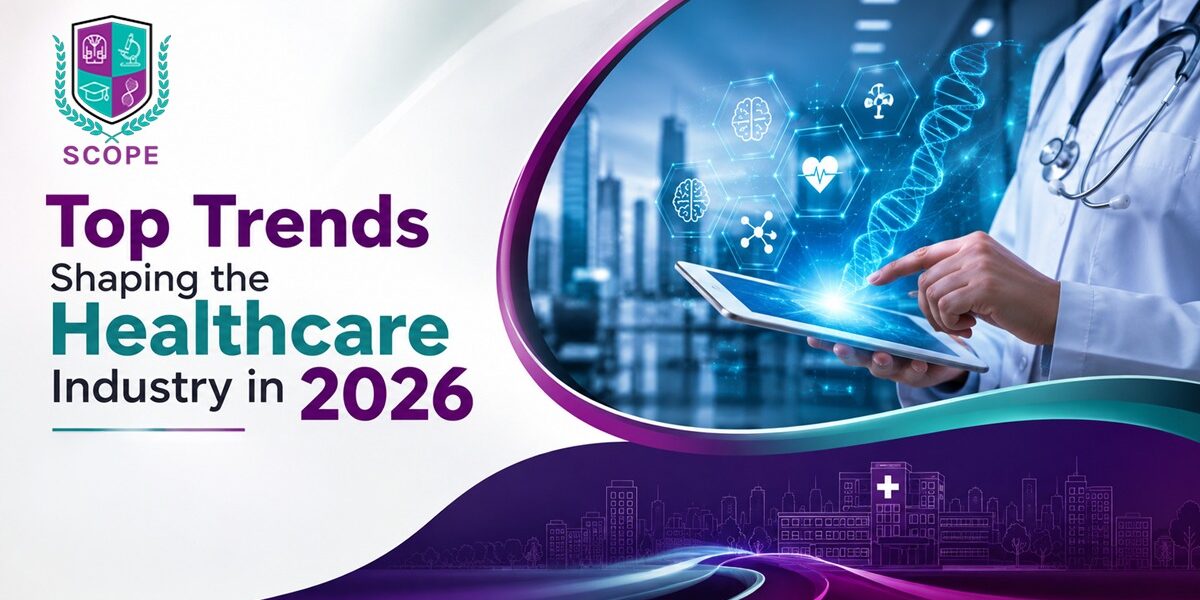
The healthcare industry is growing at a rapid pace. Improvements are widespread across diagnostic, operational, and treatment functions. The major drivers are artificial intelligence (AI) and workforce demands. But the healthcare industry trends 2026 is foreseeing are way beyond just these. It’s changing how patients are diagnosed and treated completely. In this blog, we’ll dive into ten such trends that are shaping the current & future healthcare industry.
- AI In Healthcare Trends
If you were to ask about the biggest healthcare trends 2026 has to offer, AI would definitely be on that list. This is a well-proven governmental step. The Ministry of Health and Family Welfare launched the Strategy for Artificial Intelligence in Healthcare for India (SAHI), a framework that governs the use of AI in the healthcare industry. It has been complemented by the Benchmarking Open Data Platform for Health AI (BODH), a technical testing engine developed by IIT Kanpur and NHA. This combined announcement took place at the AI Impact Summit 2026, highlighting the growth of AI in healthcare.
Currently, you can find AI being explored across:
- Medical imaging
- Disease screening
- Clinical decision support
- Patient risk assessment
- Healthcare analytics
- Administrative automation
- Drug discovery
- Public-health surveillance
However, an important thing to note is that this does not mean AI should replace humans. Instead, the more realistic direction is professionals working alongside AI.
- Digital Transformation In Healthcare
Traditional healthcare systems have become obsolete, and digital transformation has begun. What does this mean? This means adoption of:
- Electronic health records
- Digital health IDs
- Online appointments
- Telemedicine
- Digital prescriptions
- Hospital information systems
- Digital insurance processes
- Health-data exchange
An important part of this transformation has been India’s Ayushman Bharat Digital Mission (ABDM), basically promoting the interoperability and smooth functioning of digital health systems. It improves operational efficiency, service convenience, and the need for digital literacy.
- Telemedicine and Remote Healthcare Are Expanding
Today, patients don’t need to be physically present to get checked up. In simple terms, it eradicates the need for travelling long distances and provides access to people who are deprived of it. Examples of this include:
- Virtual consultations
- Tele-radiology
- Remote monitoring
- Digital follow-up consultations
- Online health services
- Remote specialist access
All of these can be executed without a single movement towards a clinic or hospital. Their use is particularly gaining popularity for follow-up and chronic disease management.
- Preventive and Predictive Healthcare Are Gaining Importance
The future of healthcare doesn’t wait for diseases to catch up before treating them. Preventive and predictive healthcare measures are the most recent trends in healthcare.
The shift can be understood as:
Reactive healthcare → Early detection → Preventive healthcare
Technology is backing this as well with:
- Health screening
- Wearable devices
- Remote monitoring
- Health analytics
- Risk prediction
- Digital health records
- Population-health programmes
This creates opportunities for healthcare professionals involved in diagnostics, preventive health, health data, and patient monitoring.
- Allied Healthcare Trends
Allied healthcare is at one of its highest peaks in India. The government plans to add 100,000 allied healthcare professionals in a five-year window. Allied healthcare professionals are of a huge help to doctors & similar staff, because they can:
- Operate diagnostic equipment
- Perform laboratory investigations
- Support cardiac care
- Assist in operating theatres
- Support dialysis procedures
- Work with medical imaging technology
- Provide emergency healthcare support
These professionals are integral to a healthcare setting. They delegate a big chunk of doctors’ involvement in assistive tasks, solely directing them towards a course of treatment.
- Medical Imaging Is Becoming More Advanced
Medical imaging is not what it was five years ago. Technology has improved drastically, and X-rays, CT scans, MRIs, ultrasound, 3D imaging, and AI-assisted image analysis have advanced. Operating this requires a certain level of expertise because trained professionals can responsibly operate equipment, prepare & position patients safely, and acquire final imaging. This expertise translates into roles such as:
- Radiology Technicians
- Radiographers
- MRI Technicians
- CT Scan Technicians
- Imaging Technologists
- Healthcare Is Becoming More Data-Driven
Every healthcare organization holds huge amounts of information. If this information is not used efficiently, it will be of no good. In hindsight, this information could be very valuable for making the right decisions. This is exactly what the field of healthcare analytics deals with. Healthcare data can be used for:
- Patient-flow management
- Resource planning
- Hospital capacity
- Disease surveillance
- Quality improvement
- Cost management
- Healthcare planning
Data scientists are the most advanced professionals in this space. But a simple skill to interpret available numbers can also be very helpful.
- Healthcare Automation Is Expanding
Healthcare has caught up with the automation wave and is increasingly delegating repetitive tasks to technology. Today, healthcare organizations are streamlining:
- Appointment scheduling
- Patient registration
- Billing
- Claims processing
- Inventory management
- Documentation
- Workflow management
- Resource allocation
Automation helps reduce the time spent on repetitive tasks so that professionals can focus on responsibilities that require human judgement and interaction.
- Healthcare Roles Are Becoming More Specialised
It’s no longer just a “doctor.” Various specialized roles can be taken up by students, specifically in areas such as:
- Medical imaging
- Laboratory diagnostics
- Cardiac technology
- Dialysis
- Operation theatre technology
- Healthcare IT
- Medical equipment
- Quality management
Instead of simply deciding that they want to “work in healthcare”, students can now consider which specific area matches their interests.
- Healthcare Education Is Becoming More Skills-Oriented
Throwback to the time when healthcare education meant dealing with a lot of books, and that meant “becoming a healthcare professional.” That’s not the case now. Healthcare has gotten pretty advanced, and students can benefit from:
- Practical laboratory work
- Medical equipment
- Clinical environments
- Digital healthcare
- Patient safety
- Data interpretation
- Communication
- Industry practices
India’s move towards competency-based curricula for allied healthcare professions reflects this broader emphasis on skills and professional competencies. The goal of healthcare education is not only to theoretically excel at technology, but to understand how to use it in real time.
Conclusion
The healthcare trends in India in 2026 point directly towards what the next era of healthcare will look like. AI & digital transformation are going to be the major forces driving what the future will look like in healthcare. If you are interested in healthcare, you should definitely be exploring courses that incorporate these trends in their curriculum. This list acts as an awareness sign—your execution will make it complete.