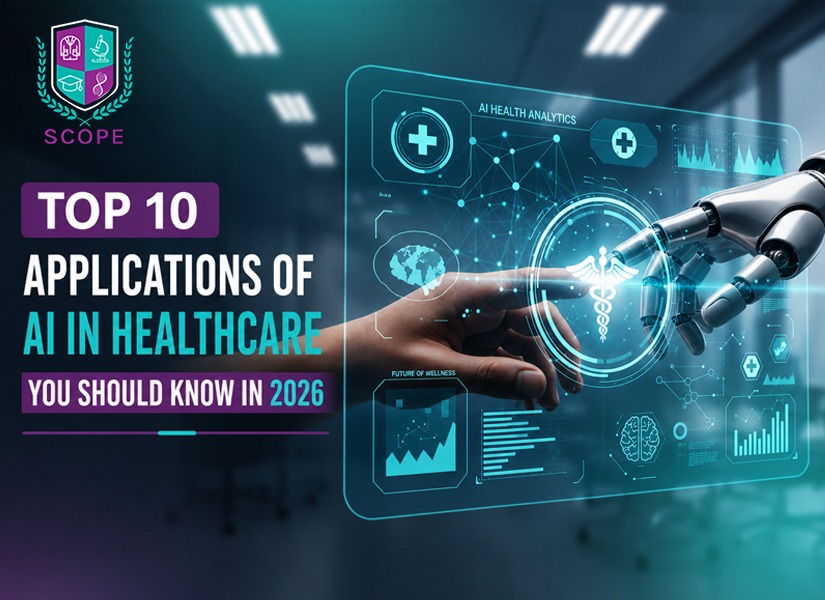
Artificial intelligence is rapidly evolving how healthcare systems work. It has made diagnoses faster, treatments smarter, and operations more efficient. What was once a task carried over for days. As we witness healthcare AI trends 2026, it is important to understand the top AI applications in the field and how they improve daily healthcare operations. In this blog, we’ll discuss ten such AI applications and how upcoming healthcare professionals can benefit from their awareness.
AI-Powered Medical Imaging
Diagnosis is the most critical element for any healthcare treatment. AI can now directly analyse X-rays, CT scans, MRIs, ultrasound images, and other radiology and diagnostic imaging. AI tools are more accurate in detecting the smallest changes and their impact on the patient. Medical imaging is already being transformed and is no longer placed among the list of AI healthcare future trends.
Predictive Disease Detection
In general, AI models work completely on their predictive models. AI in healthcare can also leverage predictive capabilities and anticipate heart disease risk, diabetes complications, cancer probability, and stroke likelihood. Earlier detection leads to preventive measures and improves outcomes.
Virtual Health Assistants & Chatbots
Chatbots have seen the widest adoption of AI in any field. Healthcare has been no exception. Most hospitals and healthcare apps have introduced chatbots that help patients by scheduling appointments, answering health-related questions, sending medication reminders, and providing basic healthcare guidance. Chatbots stand among the most crucial uses of AI in healthcare, and reduce the workload for staff.
Robotic Surgery Assistance
While robot surgeries are not a fairly new concept, the onset of AI has improved the procedures. The need for surgeons is being eradicated gradually, and benefits include smaller incisions, reduced blood loss, faster recovery time, and improved surgical accuracy. The evolution of robotic surgeries makes them the most advanced AI innovations in healthcare 2026.
Personalized Treatment Plans
For a long time, healthcare lacked treatment personalization, and it has been the need of the hour since. Among the top applications of AI in healthcare, AI systems can analyze patient history, genetics, lifestyle patterns, and treatment responses, and create a custom plan for every patient that works for them.
Generative AI in Healthcare
Most individuals might wonder how generative AI in healthcare will be implemented. Currently, it’s being used for creating medical summaries, generating medical documentation, assisting in medical research, and recommending treatment suggestions. It saves a good chunk of time for healthcare professionals and improves workflow efficiency.
AI-Based Drug Discovery
Medicine development has been a long process, but not anymore. The role of AI in modern healthcare is working with massive datasets and doing loads of work in identifying promising drug combinations faster. AI has extensive abilities in reducing costs while working faster on finding effective drugs.
Healthcare Automation Using AI
The healthcare industry is automating boring and repetitive work with AI. It ensures that healthcare professionals can focus on high-level tasks. AI automates billing systems, patient records management, appointment scheduling, and inventory tracking.
Wearable Health Monitoring Devices
Nowadays, wearable devices have also transformed and become one of the major AI healthcare applications. These devices can track heart rate, oxygen levels, sleep quality, and blood pressure. AI analyzes this data and alerts about health risks (if any).
AI in Emergency & ICU Monitoring
Artificial intelligence is an assistant to doctors and surgeons in the ICU. It is among the biggest revolutions of AI in the medical field. AI systems can detect sudden health deterioration, alert doctors instantly, and predict complications early. Emergency response becomes quicker, and patient survival rates increase.
Conclusion
The current scope of AI in healthcare is massive. It is changing the most minute aspects of how the industry functions. From diagnosis and treatment to management and monitoring, everything is being taken over by AI, and healthcare is becoming faster, smarter, and more efficient.
In such a scenario, the goal for healthcare professionals is not to submit to AI. It is to become AI-enabled, and evolve with AI. Paramedical courses in Mumbai are already catching up to this change in the industry, and helping candidates understand both medicine and technology for future success.