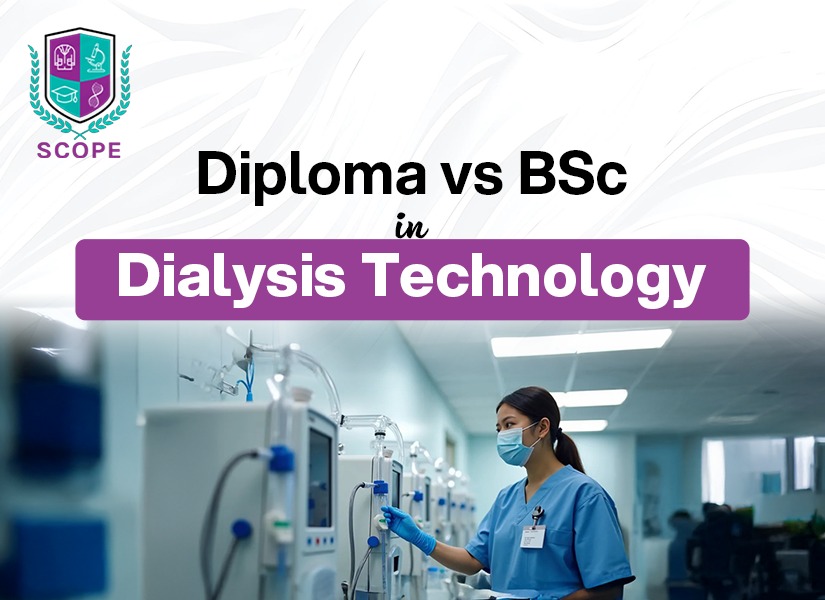
Anywhere in the world, issues related to the kidney are already very relevant and harmful for the human population, and they continue to grow too. As these issues are treated through dialysis, the growth of such issues around the world results in the growth of the need for dialysis professionals in the healthcare sector. To become a professional and fulfill these needs, two of the most preferred pathways include pursuing a Diploma in dialysis technology (DDT) as well as a BSc dialysis technology (BSc DT) course.
Both of these programs prepare the students for kidney dialysis, the procedure, the machines used, and much more at different stages. For aspirants wishing to choose a career in dialysis technology, knowing the difference between them would help them in choosing the right course for themselves.
Diploma vs BSc in Dialysis Technology
For students interested in pursuing a dialysis technology course after 12th, a diploma and a BSc in dialysis technology are considered two of the best options. There are several differences between the two courses that attract students of different preferences. Some of the differences are as follows:
Eligibility and Duration
A diploma in dialysis technology is 2 years long and can be pursued even by a student who has passed or failed the 10th standard or a 10+2 pass student from any stream. Meanwhile, a BSc in the same, which is 3 years long, can be pursued only after qualifying 10+2 with a science stream with a minimum score of 60% marks.
Career Opportunities
Both courses enable the aspirant to work in several medical and paramedical bodies, like government or private hospitals, dialysis clinics, research centres, etc. Qualified diploma holders can occupy the role of dialysis technician or dialysis assistant in the field to support senior dialysis experts in the treatment of patients. Meanwhile, holding a bachelor’s degree can enable an aspirant to fit the role of a dialysis technologist or a dialysis therapist.
Growth Opportunities
After qualifying in the DDT course, the career of an individual starts with entry-level positions. However, they can increase their eligibility or capability of holding senior-level positions with experience and growth in their skills. The same goes for a BSc in DT qualified individual, except that they start a position higher than the entry-level.
Why Choose Scope College?
We at Scope College have trained over 6000 students at our campus to date, over the 12+ years of our legacy. To help students who aspire to have an established career in the paramedical field, more particularly in the role of dialysis, we at Scope College offer diploma courses in dialysis technology. Along with our 100% placement record, we offer an excellent laboratory setting and a faculty full of experts guiding the students throughout their course duration.
We offer our students exposure to 300+ industry partners across India and abroad, along with state-of-the-art facilities, preparing them practically. At Scope College, aspirants are trained at an affordable fee with precision and expertise that is sure to make them the best paramedic individuals in their field.
Conclusion
Choosing between a Diploma and a BSc in dialysis technology can be a tough choice, but it becomes easy when you have your priorities clear. Both these courses are suitable for students of different academic backgrounds and career goals. No matter which one you choose, a successful career is guaranteed for you when you study at Scope College.
We at Scope College offer the perfect platform for students to begin their training in dialysis technology at a very affordable fee. Our faculty, full of experts, along with our placement cell and partners, make sure that you get the best training as well as the best career opportunities to put that training to use. Enroll at Scope College and make your first step towards a successful future.
Frequently Asked Questions (FAQs)
Q. Which course is the best dialysis technician?
Among a bachelor’s and a diploma in dialysis technician, which course is the best depends on the career goals, academic background, and other priorities of the student.
Q. What is the scope of diploma in dialysis Technology?
After qualifying with a diploma in dialysis technology, you can start your career at government or private hospitals, dialysis centres, or research labs in the position of a dialysis technician or dialysis assistant.
Q. Is NEET necessary for dialysis technology courses?
No, qualifying NEET is not necessary for either diploma or bachelor’s in dialysis technology courses.